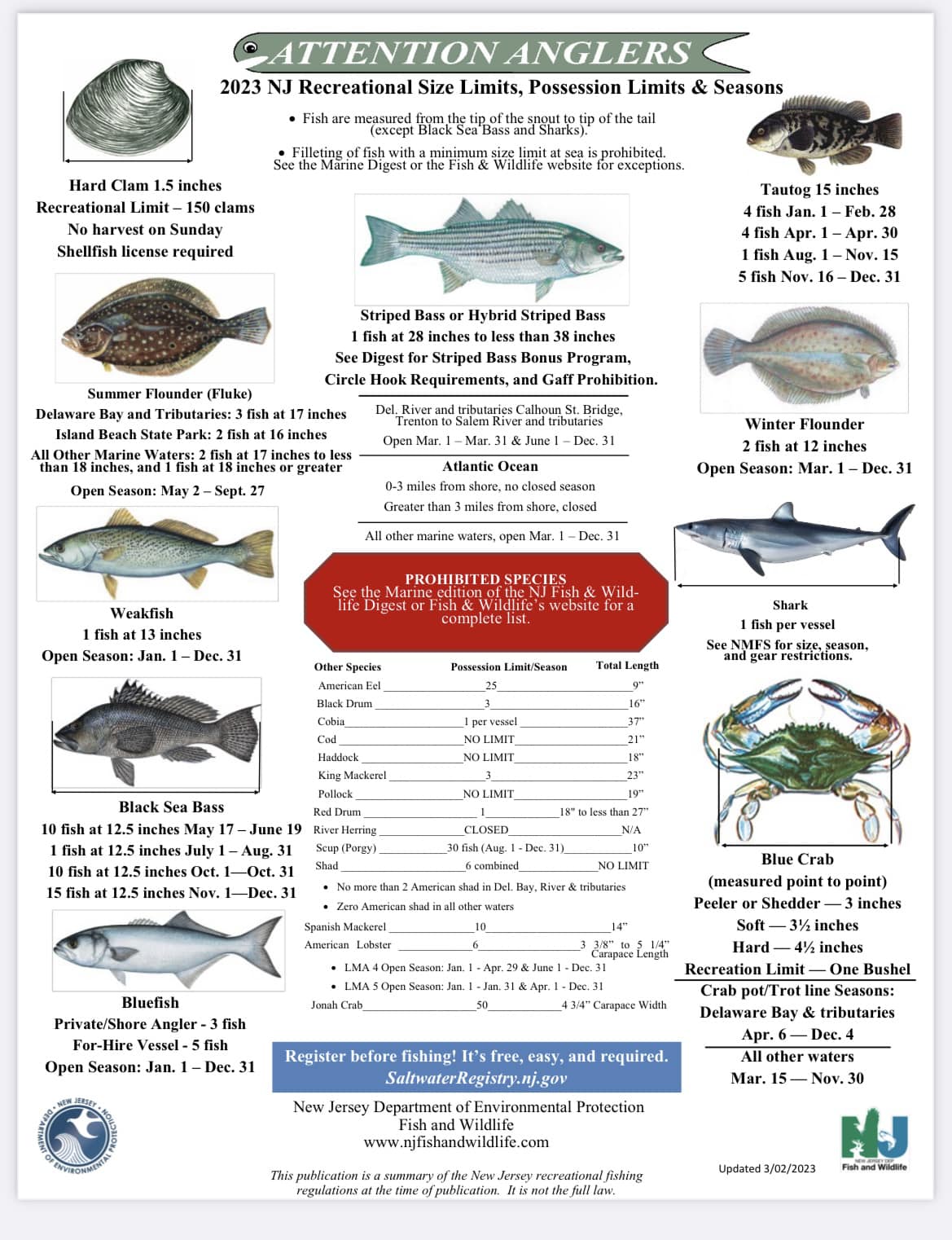
2023 NJ Saltwater Fishing Regulations
- Details
- Published: Monday, 20 March 2023 07:14
- Written by NJSWF
- Hits: 90889
2023 NJ Saltwater Fishing Regulations

Welcome to NJ Saltwater Fisherman.
Your #1 Source for all NJ Saltwater Fishing News and Information.
Please visit our Free and Friendly NJ Fishing Forums where the talk is fishing 24/7.
NO Politics... NO DRAMA.. Just Fishing!!

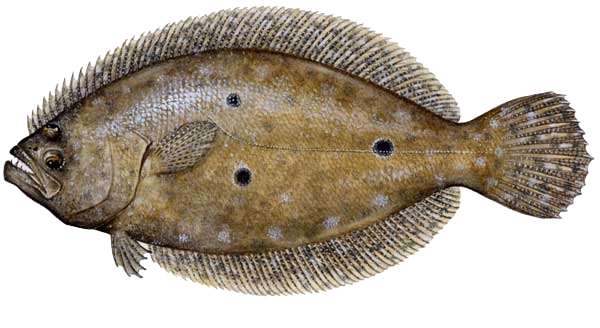
NJ Fluke Season Will start on May 2 to September 27 with a two-fish slot possession limit from 17 to 17.99 inches, with one fish at 18 inches or greater. First ever "slot" limit on fluke along the Atlantic Coast
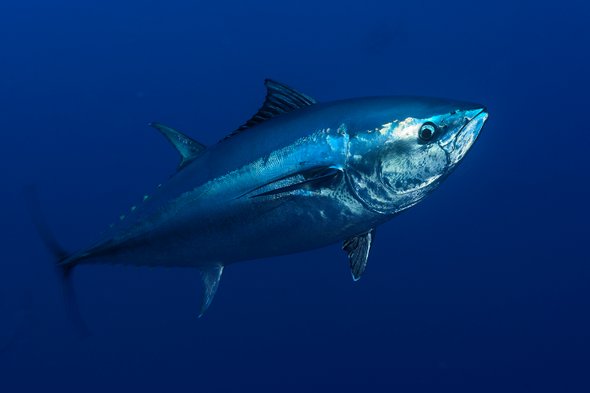

NOAA Fisheries is adjusting Atlantic bluefin tuna daily retention limits for recreational fishermen. The adjusted limits go into effect on May 2, 2021, and extend through December 31, 2021, unless modified by later action.
The table below summarizes the changes to the bluefin tuna retention limits.
Vessel/Permit Type |
Default Retention Limit per
|
Adjusted Retention Limit per
|
| Private vessels with a Highly Migratory Species (HMS) Angling category permit |
1 school, large school, or small medium (27 to <73”) |
|
| Charter boats with an HMS Charter/Headboat permit fishing recreationally |
1 school, large school, or small medium |
|
| Headboats with an HMS Charter/Headboat permit fishing recreationally |
1 school, large school, or small medium |
|
Anglers may still catch and release or tag and release bluefin tuna of all sizes, subject to the requirements of HMS catch-and-release and tag-and-release programs. All released bluefin tuna must be handled in a manner that will maximize survivability and without removing the fish from the water.
HMS Angling category and HMS Charter/Headboat permitted vessel owners are required to report the catch of all bluefin retained or discarded dead within 24 hours of landing or the end of each trip by:
This notice is a courtesy to fishery participants to help keep you informed about the fishery. Official notice of Federal fishery actions is made through filing such notice with the Office of the Federal Register.
Vessels must have a valid HMS Angling or HMS Charterboat/Headboat permit to fish for Atlantic bluefin tuna. The permit covers everyone fishing on that vessel. Tournament vessels may instead fish for bluefin with an Atlantic Tunas General category permit.
Measure curved fork length by following the curve of the fish's body from the tip of the jaw to fork of the tail.

There are new engine cutoff device wear requirements for recreational boat operators as part of the January 1, 2021, passage of National Defense Authorization Act that included a U.S. Coast Guard Reauthorization. These devices, commonly referred to as engine cutoff switches (ECOS), are designed to prevent a boat-strike injury if an operator is accidentally ejected overboard while underway.
Engine cutoff devices can be located at the helm of the boat or on the tiller or body of an outboard engine and typically connect a boat’s operator to the cutoff switch with a lanyard. Some ECOS devices eliminate the lanyard and rely on wireless proximity devices to shut down an engine if the operator goes overboard.
Effective April 1, 2021, the new law requires a vessel operator to use either a helm or outboard lanyard or wireless ECOS on certain vessels less than 26 feet when traveling on plane or above displacement speed. These vessels include (1) boats that have a functioning engine cutoff device installed at the helm or on an outboard engine or have wireless ECOS, or (2) boats manufactured beginning January 2020. The Coast Guard increased the number of boats required to have ECOS installed after this date in an effort to reduce boating accidents and fatalities.
Exceptions to the ECOS requirement include if the main helm of the vessel is in an enclosed cabin or the vessel is not operating on plane or at displacement speed. Low-speed activities such as fishing or docking do not require use of an ECOS. The vessel operator is also exempt if the boat’s motor produces less than 115 lbs. of static thrust – or about the size of a 2-hp engine.
The new law applies to all federally navigable waterways. As this is a federal law, states do not have the ability to enforce the new ECOS regulation — though seven states (Alabama, Arkansas, Illinois, Louisiana, Nevada, New Jersey and Texas) currently have their own ECOS laws. BoatUS expects most states to amend their regulations to match federal law over the coming years. While boat operators who fail to follow the new requirement could face a $100 civil penalty for the first offense, BoatUS expects the U.S. Coast Guard’s initial focus will be education.
Boaters are encouraged to check the U.S. Coast Guard website for additional information on this new use requirement and other safety regulations and recommendations.
“BoatUS supports responsible use of cutoff devices and wants to get the word out to boaters to be aware of this new requirement so they can prepare,” said BoatUS Manager of Government Affairs David Kennedy. “We believe the new requirement allows recreational boaters to operate their vessels in a practical manner while increasing boating safety.”
Kennedy suggests that boat operators double check to see that their engine cutoff switch is working and begin the season by getting into a good habit of wearing it.